




How Often to Change Water Filter Cartridges: What the Makers Say
Most cartridges need changing every 6 to 12 months, but the real answer is in your filter's manual. Here is what the makers of common Australian systems say for sediment, carbon, filter taps, UV lamps and reverse osmosis membranes, the signs a cartridge is done, what happens when one is left too long, and how to keep to a schedule.
UV lamps are changed every 12 months and reverse osmosis membranes typically last 1 to 3 years. Change sooner if the flow drops or the taste comes back, and write the date on the housing: Zip warns a spent filter is not always noticeable by taste or smell.
Licensed & insured · Lic #306457C
Book a cartridge change with a licensed plumberHow Often Each Type of Water Filter Needs Changing
These are the intervals the makers publish. Your own filter's manual beats any general rule, including this one.
| Cartridge or part | Maker's interval | Source |
|---|---|---|
| Standard cartridges, such as sediment and carbon | Every 6 to 12 months | Puretec FAQs |
| Filter and UV unit for tank water (Puretec Hybrid G and R) | Cartridges every 6 months | Puretec Hybrid G and R user guide |
| UV lamp | Every 12 months | Puretec user guides |
| Reverse osmosis membrane | Typically every 1 to 3 years | Puretec FAQs |
| Boiling and chilled tap filter (Zip HydroTap) | 12 months at most, or when the tap alerts you | Zip Water |
| Filter tap system (Billi) | About every 12 months, or at 30,000 litres | Billi |
When each part is due, by the maker's own schedule (months)
Pale bar: how long the part lasts at most. Dark band: when the maker says to change it. Sources: Puretec FAQs (standard cartridges 6 to 12 months, RO membranes typically 1 to 3 years); Puretec Hybrid G and R user guide (cartridges every 6 months, UV lamps annually); Puretec ES2 and ESR2 user guide (UV lamps every 12 months); Zip Water (12 months maximum); Billi (about 12 months, 30,000 litre chlorine reduction capacity). Retrieved 24 September 2026.
Why the Right Interval Depends on Your Water
The calendar is only a stand-in for how much work the cartridge has done.
Capacity, Not the Calendar
Billi puts it plainly: time is not an accurate measure of a filter's life, capacity is. Its filters are rated at about 30,000 litres for chlorine reduction, so a busy household reaches the limit sooner.Source: Billi, how often do water filters need replacing
Your Water and Your Household
Puretec says its under-sink cartridges need changing every 6 to 12 months, dependent on water quality and usage. Zip says lots of fine particles in the water, or more people using the tap, means changing more often.Source: Puretec ES2 and ESR2 user guide; Zip Water
Time Off Counts Too
A filter that sits unused is not resting. Puretec says to flush its under-sink systems for 10 minutes after more than 2 days without use, and that after 2 weeks or more the cartridges may need replacing.Source: Puretec ES2 and ESR2 user guide
Signs a Water Filter Cartridge Is Spent
Watch for these, but do not wait for them.
- The flow drops. Puretec's advice is to consider replacing a filter early if you notice a decline in water quality or flow rate.
- The taste or smell comes back. Carbon is there for the chlorine taste and odour, and Billi says a replacement is due once the filter reaches its capacity or the water quality deteriorates.
- A reminder light is on. Zip's change filter light flashes until the filter is replaced.
- A boiling and chilled tap is slow to refill. Zip lists the internal tank taking longer to fill as one effect of an overdue filter.
- You cannot remember the last change. Then it is due, and next time write the date on the housing.
What Happens If You Don't Change Your Water Filter
Sydney's mains water meets the national guidelines. A neglected filter is the part of the system that can let it down.
A study of homes with whole house and point-of-use filters in Doha, published in Scientific Reports in 2018, found the filters can act as traps and reservoirs for sludge, scale, rust, algae or slime deposits, which promote microbial growth and biofilm. With changes in water pressure or a disturbance of the plumbing, what was trapped can be flushed back into the tap water.
The makers say it too. Billi says organic matter builds up as a filter works, potentially leading to biofilm, and Zip says that after 12 months its filter's performance declines and contaminants begin increasing.
There is one more reason. The national health body, NHMRC, points out that home filters can reduce the chlorine residual that is there to prevent bacterial contamination, and that filters need to be properly maintained and replaced. A carbon filter takes the chlorine out on purpose, which is exactly why the cartridge schedule matters more than the brand.
What happens inside a filter that is left too long
Sources: Nriagu et al., Scientific Reports, 2018 (home filters as traps and reservoirs for deposits that promote microbial growth and biofilm); Billi (organic matter accumulates, potentially leading to biofilm); Zip Water (performance declines after 12 months, not always noticeable by taste or smell); Puretec FAQs (decline in water quality or flow rate).
Genuine, Compatible or Cheap Replacement Cartridges
Water filter cartridges are sold everywhere, and not all of them match the one that came out.
Puretec tells owners to use genuine Puretec replacements to maintain performance, warranty and Australian Standards. Zip warns that a compatible filter may fit its command centre but may not offer the same performance, and says to make sure any filter has been tested and verified to a performance standard.
The ACCC has dealt with the risk directly. In 2019 it accepted a court enforceable undertaking from Saipol Technologies, a water filter cartridge business, over promotional material for cartridges sold to business customers: the relevant health directive required a pore size of 0.2 micron, and the cartridges had a pore size of 1.0 micron.
Before you buy, match the maker's part number, and if a cartridge claims to reduce something specific, look for independent certification of that claim. Since AS 3497:2021, Standards Australia expects performance claims for drinking water treatment to be certified to NSF/ANSI standards. Our guide to WaterMark and NSF/ANSI certification explains what to look for.
Changing a Cartridge Yourself, or Calling a Plumber
An under-sink cartridge swap is often a job you can do. A whole house housing on the main water line is a bigger one.
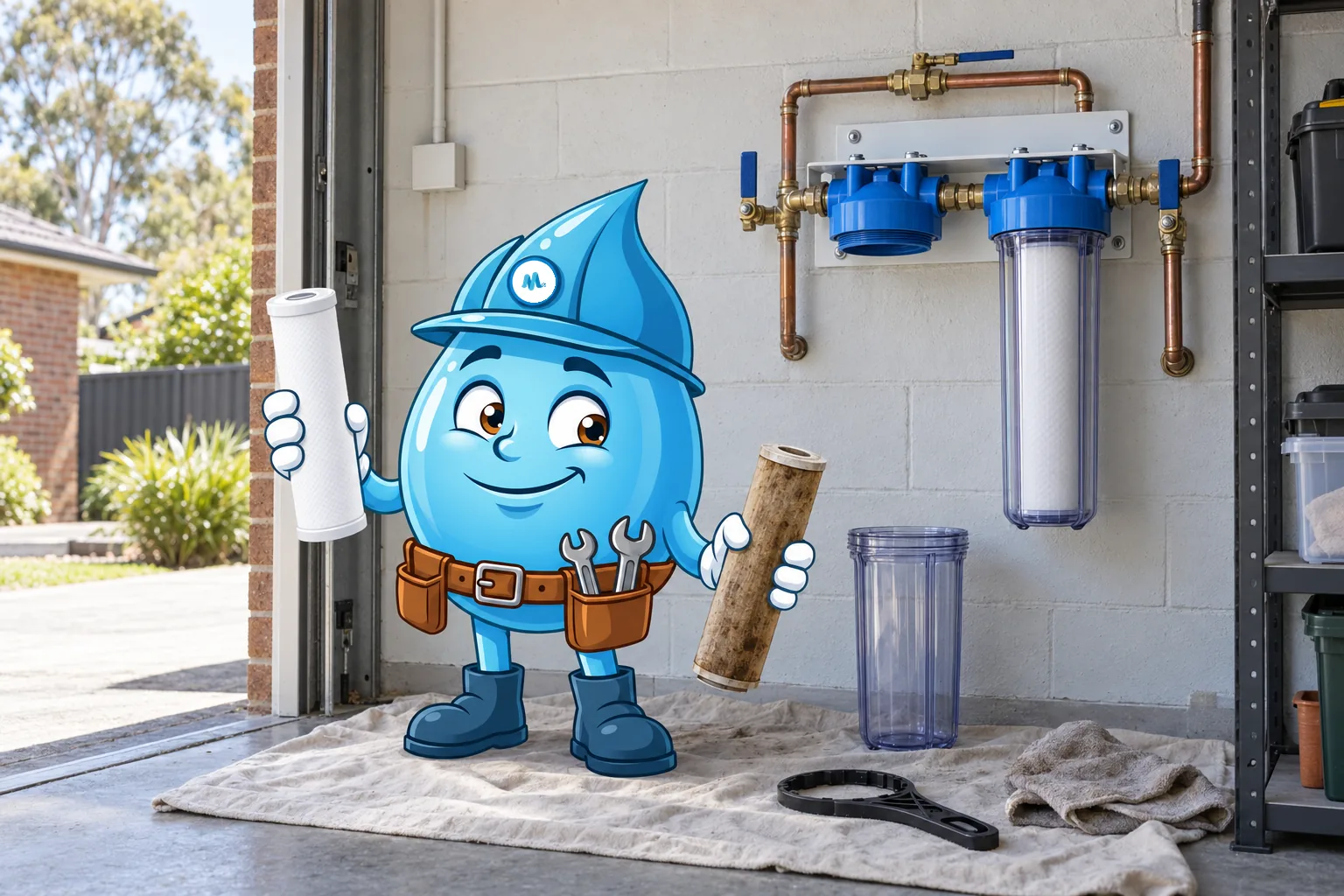
Zip and Billi both publish instructions for changing their own filters at home. A whole house housing sits on the water line into the house, so the water has to be isolated and the pressure released first, and a seal that has not seated properly can leak. Puretec says its systems must be installed by a licensed plumber and checked regularly for leaks. This is the change procedure Puretec sets out for its filter housings:
- Turn off the water to the filter and release the pressure, using a tap downstream or the pressure relief button.
- Unscrew the housing bowl, take out the old cartridge and dispose of it properly.
- Clean the bowl with warm soapy water, rinse it, and check the O-ring. Replace it if it is damaged and give it a light coat of food grade silicone lubricant.
- Fit the new cartridge so it sits over the spigot in the base of the bowl, and write down the cartridge model and the date.
- Screw the bowl back on hand tight only, open a tap downstream and turn the water back on slowly to purge the air.
- Flush the new cartridge for the time your manual gives (Puretec says 1 to 2 minutes on its Hybrid units and 5 to 10 minutes on its under-sink systems), then check every joint for leaks.
How to Keep a Filter Schedule You Will Stick To
The best schedule is the one written on the filter itself.
A sample first year for a home with a whole house filter and an under-sink filter
Built from Puretec user guides (record model and date; quartz sleeve about every 3 months; 6 month and 6 to 12 month cartridges; UV lamp every 12 months), Puretec FAQs (RO membranes 1 to 3 years), Zip Water and Billi (about 12 months). Your own system's manual sets the real dates.
- Write it on the housing. Record the cartridge model and the date at every change, as Puretec asks.
- Use the maker's reminders. Zip's command centre light flashes when a change is due. Puretec has taken the reminder light off its under-sink taps sold in Australia to meet button battery safety rules, and offers a free email cartridge reminder service instead.
- Set one calendar reminder for the shortest interval on your system, and check everything else at the same time.
- Book it with other plumbing. We change cartridges, replace cracked or leaking filter housings and fit new filters across Sydney, with a fixed price before any work starts. Our licensed plumbers (licence 306457C) back the work with a lifetime guarantee on workmanship.
Water Filter Cartridge FAQs
How often should you change a water filter?
For most cartridges, every 6 to 12 months. Puretec gives 6 to 12 months for standard cartridges, and Zip and Billi put their drinking water filters at about 12 months. Your filter's manual has the exact interval.
How often should a whole house water filter be changed?
Puretec gives 6 to 12 months for standard sediment and carbon cartridges, and 6 months on its filter and UV units for tank water. Change sooner if the flow drops or the taste comes back.
How long does a reverse osmosis membrane last?
Puretec says reverse osmosis membranes typically need replacing every 1 to 3 years. The standard cartridges in the same system follow Puretec's 6 to 12 month schedule.
How often should a UV lamp be replaced?
Every 12 months. Puretec says its UV lamps must be replaced annually to maintain a 99.9% kill rate of bacteria.
What happens if you don't change your water filter?
Its performance drops, and it can start to work against you. A 2018 study found home filters can trap sludge, scale and slime that promote microbial growth, and that the trapped material can be flushed back into the tap water.
Can I use cheaper compatible cartridges?
Check first. Puretec says to use genuine replacements to maintain performance and warranty, and Zip warns a compatible filter may fit but not perform the same. If a cartridge claims to remove something, look for independent certification of that claim.
Can I change a water filter cartridge myself?
Often, yes, on an under-sink filter, following the maker's instructions. A whole house housing on the main water line needs the water isolated and the pressure released, and a badly seated seal can leak, so it is a good job for a licensed plumber.
Related: Water filter installation · Whole house water filters · Is Sydney tap water safe to drink? · Whole house water filter disadvantages · Whole house or under-sink filter · WaterMark and licensed installation