



WaterMark Certification for Water Filters: Why a Licensed Plumber Matters
A water filter plumbed into your supply is a plumbing product, and filters are on the national list of products that must be WaterMark certified and fitted by a licensed plumber. Here is what the WaterMark tells you, what it does not, how to check a product before you buy, the NSW licensing rules, and the separate certification that proves what a filter removes.
WaterMark tells you a product is fit for purpose and authorised for installation. It does not tell you what the filter removes: that is a separate NSF/ANSI certification, claim by claim. Check both before you buy, and check your plumber's licence too.
Licensed & insured · Lic #306457C
Get a licensed plumber to fit your filterWhat Is WaterMark Certification?
WaterMark is the national certification scheme for plumbing and drainage products, run by the Australian Building Codes Board (ABCB).
The National Construction Code requires any plumbing or drainage product of a type listed on the WaterMark Schedule of Products to be WaterMark certified. In the ABCB's words, it must be certified before it can be installed and must be installed by a licensed plumbing practitioner. That applies to products bought from online stores too.
It is legal to sell uncertified plumbing products in Australia, which is why the mark matters: if the product type is on the Schedule and the product is not certified, a licensed plumber is not permitted to install it.
The Mark
A certified product is marked with the WaterMark trademark, its WaterMark licence number and the specification it was certified to.Source: ABCB, what is WaterMark
The Database
Every certified product is listed on the WaterMark product database, which you can search by licence number, product type, brand, model name or ID, or the licensee's name.Source: ABCB, what is WaterMark
The Scope of Use
Each certified product comes with a Scope of Use statement that sets out its intended use.Source: ABCB, what is WaterMark
Do Water Filters Need WaterMark Certification?
Yes, when they connect to your water supply. The ABCB's current Schedule of Products lists them by name.
| Product type on the Schedule | What it covers | Specification |
|---|---|---|
| Water filters and water treatment appliances | Point of use and point of entry drinking water systems, including carbon filters, UV systems, reverse osmosis systems and microbiological purifiers | AS 3497 (2021), lead free rules apply |
| Water conditioner | In-line or end-of-line devices for conditioning water and preventing scale | AS 3497 |
| Other water treatment systems | Water treatment units upstream of appliances, and UV for non-drinking uses such as bathing | WMTS-103 (2016) |
Point of entry is the plumbing term for a whole house filter on the main line into the home. Point of use is a filter at one tap, such as an under-sink filter. Both are on the Schedule. A filter jug on the bench is not connected to your plumbing at all, so none of this applies to it.
The four checks between a filter on a shelf and filtered water at your tap
Sources: ABCB, WaterMark Schedule of Products 2026-1; ABCB, what is WaterMark. Retrieved 24 September 2026.
WaterMark and NSF/ANSI: Two Different Questions
This is the part most buyers miss. WaterMark does not tell you what a filter takes out of your water.
The Australian standard for drinking water treatment systems, AS 3497:2021, covers everything from a small under-sink filter in a home to commercial filtration for a large building. When Standards Australia revised it in 2021, it removed the old Australian performance test and required all performance claims to be certified to NSF/ANSI standards, to make it harder for unsubstantiated and untested products to reach the market.
So a filter can be WaterMark certified and still claim nothing about lead or PFAS. If a filter promises to reduce a particular thing, look for that exact claim in its NSF/ANSI certification. The ACCC puts the seller's side simply: a business must be able to prove any claim it advertises.
| WaterMark | NSF/ANSI certification | |
|---|---|---|
| The question it answers | Is this plumbing product safe, fit for purpose and authorised for installation? | Does the filter actually reduce what its label says it reduces? |
| Who runs it | Australian Building Codes Board, under the National Construction Code | NSF standards, tested and listed by a certifier |
| For a water filter | Required before a licensed plumber can install it | Required for performance claims under AS 3497:2021 |
| What to look for | The WaterMark, a licence number and a listing on the WaterMark product database | The standard and the specific claim, for example NSF/ANSI 42 for chlorine, taste and odour |
| What it does not tell you | What the filter removes | Whether the product may be installed in Australia |
| Standard | What it covers | Examples of claims |
|---|---|---|
| NSF/ANSI 42 | Aesthetic effects, meaning contaminants that are not health related | Chlorine, taste and odour, chloramine, particulate |
| NSF/ANSI 53 | Health effects, with over 50 possible contaminant reduction claims | Lead, Cryptosporidium, VOCs, chromium |
| NSF/ANSI 58 | Reverse osmosis drinking water systems | Total dissolved solids (required), plus optional claims such as fluoride, lead and nitrate |
| NSF/ANSI 401 | Emerging compounds, up to 15 individual contaminants | Some prescription and over-the-counter medications, herbicides, pesticides |
Who Can Install a Water Filter in NSW
In NSW, connecting a filter to your water supply is plumbing work, and plumbing work needs a licence.
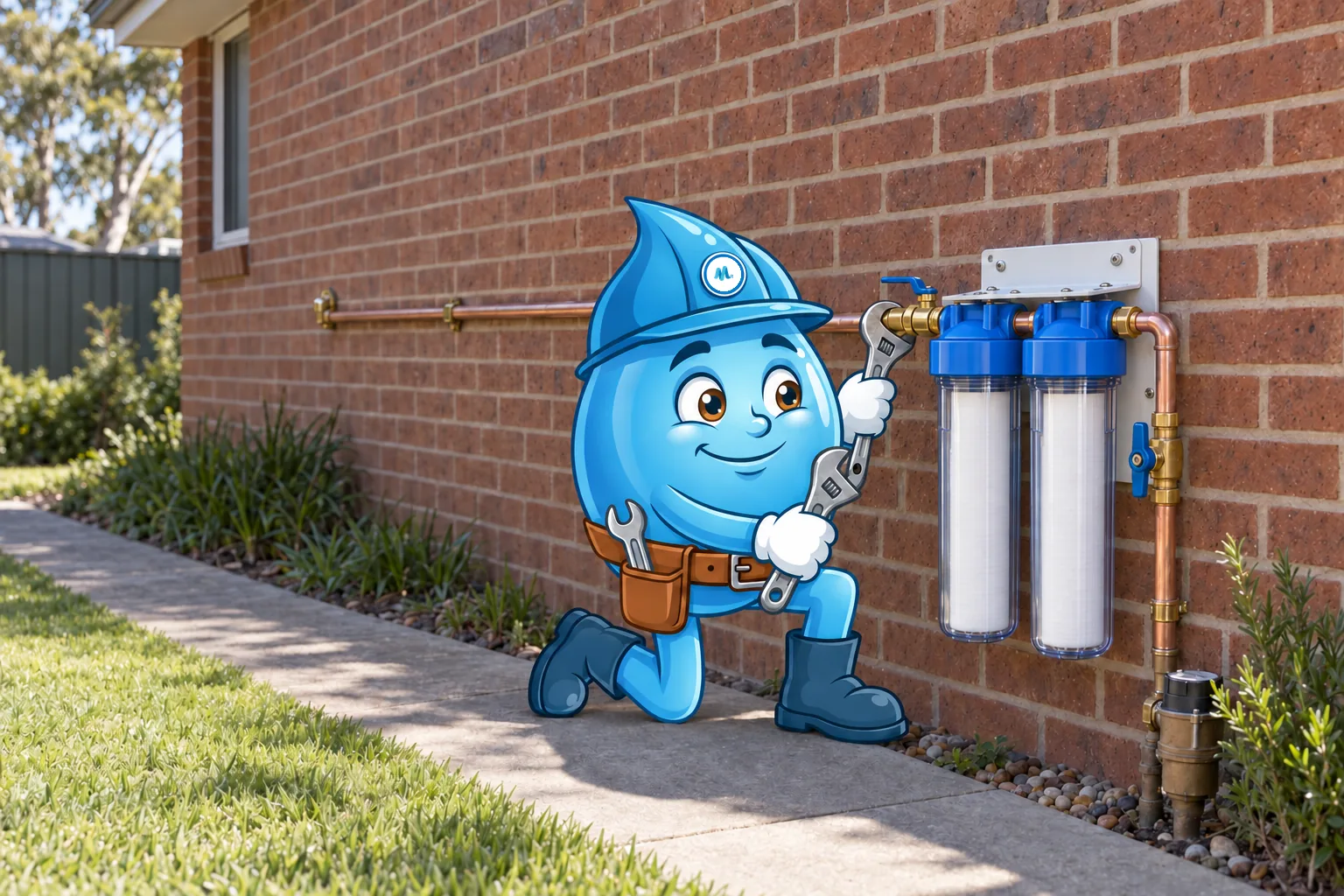
The NSW Government defines water plumbing as work carried out in connection with the supply of water, including installing pipes, fixtures, appliances and fittings designed to convey, store, protect, treat, mix, measure, modify or regulate the flow of water. You need a licence or certificate to do any plumbing work, regardless of the cost of the work. Under the Home Building Act 1989, unlicensed plumbing can bring a fine of $22,000 for an individual or $110,000 for a company, according to the NSW Government's published penalties.
Plumbing in NSW is regulated by Building Commission NSW. You can check any plumber's licence on the Service NSW licence check using their name, licence number or ABN. Ours is 306457C.
What Can Go Wrong With a DIY or Non-Certified Filter
Most of these are not safety scares. They are the practical ways a cheap shortcut becomes an expensive one.
- A plumber cannot install it. If the product type is on the Schedule and the product is not WaterMark certified, a licensed plumber is not permitted to fit it, and your local plumbing authority may not accept the installation.
- Insurance and repair costs. The ABCB lists the consequences of using non-certified products where certification is required: the cost of replacing materials, product failure causing building damage and loss, and possible voided insurance.
- The warranty. Puretec, for example, says its under-sink systems must be installed in accordance with local plumbing regulations by a licensed plumber, and that faulty operation due to unqualified persons will result in voided warranty coverage.
- Pressure. Puretec's guides say that where the line pressure exceeds 500 kPa, an approved pressure limiting device must be installed to comply with the Australian and New Zealand plumbing standards. A licensed plumber checks this before the filter goes in.
- Backflow. Sydney Water defines backflow as the unintended flow of water from a potentially polluted source into a drinking water supply, and requires licensed plumbers to fit protection that matches a property's hazard rating.
- Slow leaks. A filter housing or fitting can leak quietly in a closed cupboard until the cabinet is damaged, which is why Puretec recommends a drain pan or leak detector where a leak could cause damage.
Lead Free WaterMark: What Changes From 2026
The rules are tightening for products that touch drinking water, water filters included. The ABCB notes that the old lead levels still met the Australian Drinking Water Guidelines, and that lead free products will improve public safety further.
Lead free WaterMark: the dates that matter
Source: ABCB, lead free plumbing products. Lead free means a weighted average lead content of not more than 0.25% in parts in contact with drinking water (Plumbing Code of Australia 2022). The WaterMark Schedule marks water filters as a product type the lead free rules apply to.
How to Check a Water Filter Before You Buy
Five minutes of checking before you buy saves a return trip, or a filter nobody can legally fit.
We fit under-sink filters, filter taps and whole house water filters across Sydney, including ones customers have already bought if they can be legally installed. Our licensed plumbers (licence 306457C) give you a fixed price before any work starts and a lifetime guarantee on workmanship. See our water filter installation service.
- Look for the WaterMark and a licence number on the product or its packaging. If you are buying online and it is not shown, ask the supplier for the certification details, as the ABCB advises.
- Search the WaterMark product database for the licence number, brand or model to confirm the certification is real and current.
- Check the performance claims. For each thing the filter says it reduces, find the matching NSF/ANSI standard and claim. No certified claim, no promise.
- Check the plumber. Look up the licence on the Service NSW licence check before any work starts.
- Get the price in writing. Ask for one fixed price covering the filter, the valves and the connection, before anyone cuts into a pipe.
WaterMark and Water Filter FAQs
What is WaterMark certification?
WaterMark is the national certification scheme for plumbing and drainage products, run by the Australian Building Codes Board. Products of a type on the WaterMark Schedule of Products must be certified before they can be installed, and installed by a licensed plumber.
Do water filters need WaterMark certification?
Yes, if they connect to your water supply. The WaterMark Schedule of Products lists water filters and water treatment appliances, including carbon, UV and reverse osmosis systems. A jug filter is not connected to your plumbing, so it does not.
Is WaterMark the same as NSF certification?
No. WaterMark says a product is fit for purpose and authorised for installation. NSF/ANSI certification says what a filter reduces, one claim at a time, such as NSF/ANSI 42 for chlorine, taste and odour. A good filter has both.
Can I install a water filter myself in NSW?
Not one that connects to your water supply. In NSW, installing an appliance that treats water is water plumbing, which needs a licence regardless of the cost of the work. A filter jug needs no plumber.
How do I check if a product is WaterMark certified?
Look for the WaterMark and a licence number on the product or packaging, then search the WaterMark product database by licence number, brand, model or licensee. If buying online, ask the supplier for the certification details.
Can a plumber install a water filter I bought online?
Only if it can be legally installed. If the product type is on the WaterMark Schedule and the product is not certified, a licensed plumber is not permitted to install it. Check the database before you buy.
What does lead free WaterMark mean?
Lead free means a weighted average lead content of not more than 0.25% in parts that touch drinking water. From 1 May 2026 manufacturers can only produce Lead Free WaterMark certified products, and the installation transition runs to 1 May 2028.
Related: Water filter installation · Whole house water filters · Is Sydney tap water safe to drink? · How often to change water filter cartridges · PFAS in Sydney water: which filters remove it · Filter tap or under-sink filter