




Whole House Water Filter Disadvantages: The Honest List
Most pages about whole house filters are written to sell one. This one starts with the downsides: what it costs to own, what happens when cartridges are skipped, why a small system drops your pressure, where it has to go, what it cannot remove, and why many Sydney homes do not need one. Then, when it is still worth it.
The other downsides are the upfront cost, a cartridge bill every year, a pressure drop if the system is too small for your home, space near your main, and PFAS, which whole house carbon does not remove reliably. Sydney's mains water already meets the national guidelines, so a filter is a choice for taste, smell and comfort.
Licensed & insured · Lic #306457C
Talk to a licensed plumber about a whole house filterThe Disadvantages at a Glance
Seven honest downsides, why each one happens and what deals with it. Each is covered in more detail below, with its source.
| Disadvantage | Why it happens | What deals with it |
|---|---|---|
| 1Upfront cost | A system, a licensed plumber and valves at your main | A written, itemised quote you can compare |
| 2Cartridges every year | Cartridges fill up and stop working | A change schedule you keep |
| 2Worse water if neglected | Old cartridges trap deposits that can grow bacteria | Changing cartridges on time |
| 3Pressure drop | A system too small for your home's flow | Sizing it to your home and bathrooms |
| 4Space and access | It sits on the main and needs room to service | Planning the spot before you buy |
| 5Not a PFAS fix | Whole house carbon gives variable PFAS results | An under-sink RO or dual-stage filter |
| 6You may not need it | Sydney mains water meets the national guidelines | Buying for taste and comfort, or not at all |
1. The Upfront Cost
A whole house filter is a plumbing job, not an appliance you plug in. The figures below are published market prices, not Mr Splash prices.
Specialists publish installed prices for one system of about $3,000 to $4,000: Great Water Filters lists $2,995 and $3,995 installed, and All Home Filtration in Sydney starts from $3,990. Shelf kits cost less (Bunnings lists Stefani whole of house kits from $261 to $760), but they are supply only, and WaterMark rules require a certified product installed by a licensed plumbing practitioner.
Cost is also why many households never buy one. A 2020 survey of 581 households in Catalonia, Spain, found lower incomes and renting a flat reduced the chance of having an installed system, because of the investment, the running costs and the space it needs. Our whole house water filter cost guide breaks the price down line by line.
2. Cartridges That Must Keep Being Changed
This is the downside that matters most, because a neglected filter does not just stop working. It can make your water worse.
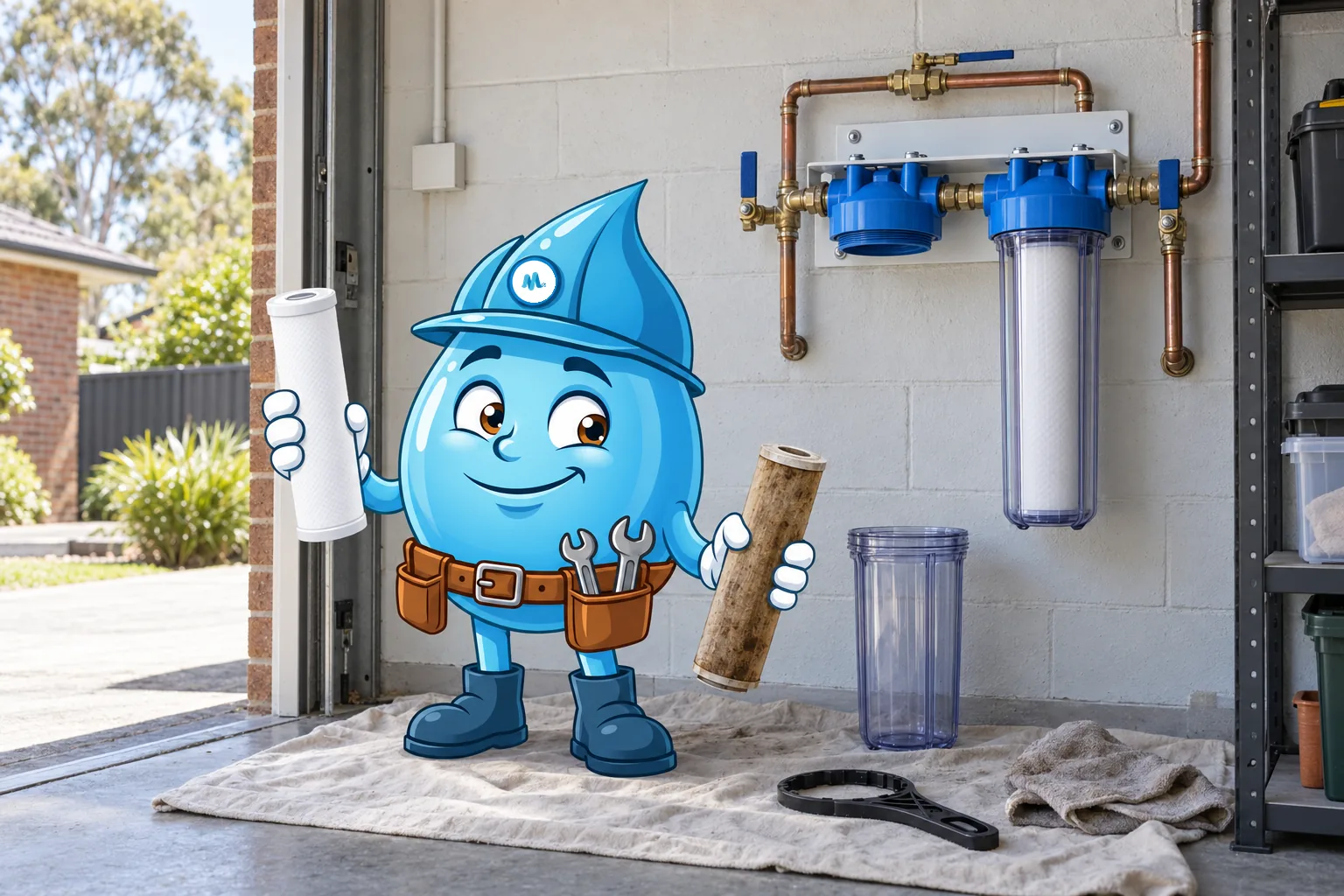
A study of homes in Doha, Qatar, with point-of-entry and point-of-use filters found the devices can act as traps and reservoirs for sludge, scale, rust, algae or slime deposits that promote microbial growth, and that changes in water pressure can flush those contaminants into the tap water (Scientific Reports, 2018). NSW Health's rainwater tank advice says the same of filters: it should be correctly installed, maintained and replaced regularly, or it becomes ineffective and can allow bacteria to grow that are then released into the filtered water.
There is a trade-off built in, too. NHMRC notes that home filters can reduce beneficial chemicals in drinking water, such as the chlorine residual that prevents bacterial contamination and the fluoride that protects teeth. A whole house carbon filter removes chlorine on purpose, because that is what improves the taste and smell. Published cartridge costs run from $295 to $395 a year for Great Water Filters' packs to a $400 flat rate for a fitted annual change at All Home Filtration.
What happens to a cartridge over time
Replacement window from Puretec's FilterWall FAQ. Other makers publish 12 months (Great Water Filters) or 12 to 18 months (Select Plumbing and Gas), so follow the schedule for your system.
3. A Pressure Drop If the System Is Too Small
Every filter slows water a little as it passes through. The question is whether you notice it in the shower.
Puretec explains it plainly: its smaller FilterWall F3 and F4 have a lower flow rate because smaller cartridges and filter bowls cause a noticeable pressure drop, which is why it suits them to smaller homes with one bathroom and its larger F5 and F6 to homes with several. My Water Filter gives the same advice: large family homes need high-flow 20 inch systems to prevent pressure drops.
Flow can also fall later. Puretec lists reduced flow as a sign a cartridge is due, and HG PureWater notes that restrictive fittings, excessive pipe runs or loaded cartridges can all affect performance. A system sized to your home, with sensible pipework and cartridges changed on time, avoids most of it. Great Water Filters, for example, claims less than 5% reduction in flow for most household setups on its ES5Q.
Rated flow of three whole house systems, litres per minute
Makers' published flow ratings (Puretec FilterWall F Series; Great Water Filters ES5Q), retrieved 24 September 2026. A household running several taps at once asks more of a system than a small one does (HG PureWater), so size to your home, not to the price.
4. It Needs Space Near Your Main, and Access for Life
A whole house filter cannot go wherever is convenient. It goes where the water comes in, and someone has to be able to service it for years.
- It sits on the main. Puretec says its FilterWall should be installed where the mains supply enters your home, so all the water is filtered. HG PureWater notes that many Australian systems sit beside an external wall for that reason.
- It needs working room. A technician has to isolate the system, relieve the pressure, remove the housings and pull the cartridges, so it needs clearance below and space in front, not just room for the unit (HG PureWater).
- It needs shelter. The spot has to allow for direct sunlight, weather, knocks and drainage. Covers help, but they do not replace a suitable location (HG PureWater).
- The valves must stay reachable. Isolation valves and the bypass should be easy to find, not hidden behind fixed structures. Water through the bypass is not filtered, so it is for servicing only (HG PureWater).
- Space is a real barrier. The Catalonia survey named the space needed in the home as one reason renters in flats were less likely to have an installed system.
5. It Is Not the Answer to PFAS
If PFAS is the reason you are looking, a whole house carbon filter is the wrong tool.
A peer-reviewed study of home filters found that all under-sink dual-stage and reverse osmosis filters tested showed near complete removal of the PFAS evaluated. Whole house activated carbon systems gave variable results, and in four of the eight tested, PFAS levels were higher in the filtered water (Herkert et al., Environmental Science and Technology Letters, 2020).
The exposure that matters is drinking. NHMRC says exposure to PFOS and PFOA during showering and bathing is considered negligible, so filtering the shower does not address PFAS. If you do choose a filter for it, NHMRC says it should be proven to remove PFAS by independent testing, then properly maintained and replaced. For drinking water, that points to an under-sink reverse osmosis or dual-stage system at the kitchen. More in PFAS in Sydney water: which filters remove it.
6. You May Not Need One at All
The honest starting point is that Sydney's tap water is fine to drink.
It Meets the Guidelines
Sydney Water reports PFAS below the national guideline values at every plant, and NHMRC says households on a supply below those values do not need additional home water treatment.Sources: Sydney Water; NHMRC
NSW Health Backs the Mains
NSW Health recommends people in urban areas use the public water supply for drinking and cooking because it is generally filtered, disinfected and fluoridated.Source: NSW Health, rainwater tanks
It Is Already Soft
Sydney Water puts Greater Sydney's water at about 57 mg/L of calcium carbonate, which is soft, so most Sydney homes do not need a softener either.Source: Sydney Water, water analysis
When a Whole House Filter Is Still Worth It
None of this makes a whole house filter a bad buy. It makes it a considered one.
If you go ahead, buy it well: a WaterMark certified system sized to your home's flow, isolation valves and a bypass, a spot with room to service it, and a cartridge schedule you will keep. Mr Splash gives free quotes with one fixed price before any work starts, a lifetime guarantee on workmanship and 0% interest payment plans, and we will tell you if you do not need a filter. See our whole house water filters.
- You notice chlorine at every tap and in the shower. A carbon stage takes the chlorine taste and smell out across the house, not just at the kitchen. The Catalonia survey found taste, odour and lime are what push households towards home treatment.
- You want the chlorine out of the shower. Some people find their skin and hair feel less dry once the chlorine is gone. The research on chlorine and skin is still uncertain, so we won't promise it will fix a skin condition.
- You are on tank water. If you drink it, NSW Health's advice covers disinfection such as UV, and filters that meet a standard such as AS/NZS 4348 or NSF/ANSI 53.
- You will keep up the cartridges. The biggest downside on this page is the one you control.
Whole House Water Filter Disadvantages FAQs
What are the disadvantages of a whole house water filter?
The upfront cost, cartridges to replace every year, the risk of worse water if they are skipped, a pressure drop if the system is too small, the space it needs near your main, and weak PFAS removal. In Sydney you may not need one at all.
Does a whole house water filter reduce water pressure?
A little, and more if the system is undersized or the cartridges are clogged. Puretec says its smaller models cause a noticeable pressure drop, which is why higher-flow systems are matched to homes with more bathrooms.
What happens if you do not change a whole house water filter?
It stops working and can make the water worse. A 2018 study found filters can trap sludge and slime that promote bacteria growth, and NSW Health warns an unmaintained filter can release bacteria into the filtered water.
How often do whole house filter cartridges need changing?
Puretec says 6 to 12 months, depending on usage and water quality. Other makers publish 12 months or 12 to 18 months. Reduced flow or a change in taste and odour means a change is due.
Does a whole house water filter remove PFAS?
Not reliably. A 2020 study found whole house carbon systems gave variable results, with higher PFAS after the filter in four of eight. Under-sink reverse osmosis and dual-stage filters removed the PFAS tested almost completely.
Is a whole house water filter worth it in Sydney?
Not for safety: Sydney's water meets the national guidelines. It can be worth it for the chlorine taste and smell at every tap and shower, if you will keep up the cartridges.
Do I need a plumber to install a whole house water filter?
Yes. It connects to your water supply, and WaterMark rules require a certified product installed by a licensed plumber.
Related: Whole house water filters · Whole house water filter cost · Whole house or under sink? · Is Sydney tap water safe to drink? · PFAS in Sydney water · Water filter installation