




Rainwater Filter for Drinking Water: Is Tank Water Safe to Drink?
It can be. NSW Health says a properly maintained rainwater tank can provide good-quality drinking water, and it recommends town water for drinking in urban areas that have it. On tank water, the roof, gutters and tank do most of the work and a filter stack finishes the job. Here is what NSW Health advises, what a first flush diverter does, what each filter stage removes, and when to get the water tested.
In urban areas with town water, NSW Health recommends it for drinking and cooking because it is generally filtered, disinfected and fluoridated. If tank water is your drinking water, keep the roof, gutters, first flush diverter and tank clean first. Then choose filtration for the job: sediment stages for dirt, carbon for taste and smell, and a UV stage to disinfect the water on its way to the tap.
Licensed & insured · Lic #306457C
Talk to a licensed plumber about filtering tank waterWhat NSW Health Says About Drinking Tank Water
NSW Health's rainwater tank guidance, current as at 11 September 2026, says yes, with conditions, and the conditions are mostly about looking after the tank rather than buying equipment.
Clear water is not a guarantee, because contamination is not always visible, and anyone with a severely weakened immune system should talk to their doctor first. One more difference from town water: NHMRC says testing a private supply such as a tank or bore is the owner's job. On Sydney Water's supply, the utility tests the water; on a tank, you do.
It Can Be Safe to Drink
Rainwater from a well-maintained roof and tank that looks clear, with little or no taste or smell, is probably safe to drink and unlikely to cause illness for most users, NSW Health says.Source: NSW Health, Managing rainwater tanks for safe drinking water
Town Water First, Where You Have It
NSW Health recommends people in urban areas use the public supply for drinking and cooking, because it is generally filtered, disinfected and fluoridated. Rainwater has no fluoride in it.Source: NSW Health, Managing rainwater tanks for safe drinking water
The Two Real Risks
Germs from birds and other animals on the roof pose the biggest risk. The other is chemicals, mainly lead from roof flashing, older solder and brass fittings, or some grades of PVC pipe.Source: NSW Health, Rainwater Treatment Fact Sheet
Stop the Dirt Before It Reaches the Tank
The cleaner the water going into the tank, the less any filter has to do. Most of this is cheap, and it is where NSW Health puts the emphasis.
Where the dirt gets stopped, before the water ever reaches a filter
Steps 1, 3, 4 and 5: NSW Health, Managing rainwater tanks for safe drinking water (current as at 11 September 2026) and Rainwater Treatment Fact Sheet. Step 2 and the roof materials: Sydney Water, Rainwater tanks installation checklist.
What a first flush diverter does. The first water off a roof when it rains carries most of the built-up dust and leaf litter. A first flush diverter sits on the downpipe between the gutter and the tank and captures that first water, so it never reaches the tank. Empty it after each rainfall, NSW Health says.
The roof matters too. Lead flashing and roofing screws with lead washers should be replaced with non-lead alternatives, or painted over where they cannot be. Sydney Water adds that rainwater should not be collected from roofs with lead-based paint, bitumen-based products or exposed treated timber.
Tank Maintenance: What to Do and How Often
NSW Health sets out a simple routine. None of it needs special tools, apart from the sludge clean.
A tank care calendar you can stick on the fridge
Every day
- Run the rainwater tap for 10 seconds before drinking.
- Run it for at least 2 minutes if it has not been used for more than 48 hours.
- Check the water is clear and smells normal.
After every rain
- Empty the first flush diverter so it can catch the next first flush.
- Now and then, clear the weep hole and rinse the filter and ball.
Every 3 to 4 months
- Clear leaves and debris from gutters and the roof.
- Cut back branches hanging over the roof.
- Check small animals cannot get into the tank.
Every 6 to 12 months
- Look inside the tank for sludge.
- Siphon it out, or have the tank professionally cleaned.
At least once a year
- Inspect the inlet and overflow screens.
- Fix any hole or gap an animal could use.
- Change filter cartridges on the maker's schedule.
Tank tasks: NSW Health, Managing rainwater tanks for safe drinking water, September 2026. The cartridge reminder is ours: a filter only works while its cartridge is fresh.
The daily flush is about the pipes: the first water out each morning can carry more lead and copper from fittings, so use it on the garden. For sludge, NSW Health strongly recommends a professional tank cleaner, especially if it means getting inside the tank.
The Filter Stack for Drinking Tank Water
A drinking water system for a tank is a set of stages, each with one job. This is what each one does and, just as important, what it does not do.
The filter stack for drinking tank water, in the order the water meets it
Stages 2, 3, 5 and 6: NSW Health Rainwater Treatment Fact Sheet. Stage 4 order: Puretec, Hybrid E series FAQ (sediment, then carbon on selected models, then UV). Pump side: Puretec FAQ. Chemicals and lead: NSW Health Rainwater Treatment Fact Sheet.
| Stage | What it does | What it will not do |
|---|---|---|
| Sediment cartridge | Removes sediment and bacteria | Will not remove viruses |
| Activated carbon | Reduces iron, hydrogen sulphide, unpleasant tastes, odours and colour | Will not remove bacteria or viruses |
| UV disinfection | Effective against most bacteria, viruses and protozoa, with no chemicals added | Does not remove chemicals; needs power and clear water |
| Reverse osmosis | Removes microorganisms and most residual chemicals | Sends a constant waste stream to the drain while it runs |
Two cautions. A filter stack is extra protection, not a substitute for tank care. And Sydney Water warns that many filters clog quickly on rainwater, which makes the pump work harder, so choose cartridges made for rainwater.
In plain terms, carbon is the stage you taste and UV is the stage that deals with germs. For a better tasting glass from a well-kept tank, sediment and carbon may be enough. If the tank is your only drinking water and you want it disinfected every time, add the fine sediment stage and a UV lamp.
What to Check Before You Buy a Rainwater Filter
NSW Health publishes a buying checklist for rainwater treatment. These are the points that separate a system that works from one that only looks the part.
- Capacity. It should treat all the water you need; finer filters slow the flow and need more attention.
- Certification. The WaterMark, plus NSF/ANSI 53 or AS/NZS 4348, and proof of testing against any specific contaminant it claims to remove.
- Mains-pressure rating. Equipment running above 150 kPa must comply with AS/NZS 3497.
- For UV, the full kit. Pre-filters, a UV intensity sensor with an alarm, automatic shut-off if the UV drops or the power fails, and NSF/ANSI 55 Class A, AS/NZS 3497 or AS/NZS 4348.
- A pressure limiting valve where needed. Where line pressure exceeds 500 kPa, an approved pressure limiting device must be fitted under AS/NZS 3500.1, as Puretec notes on its rainwater UV systems.
Published Market Prices
Puretec's published suggested retail prices for whole home rainwater filters run from $445.15 to $1,183.49 without UV, and from $1,580.87 to $4,717.43 with UV, product only; its weatherproof pump-station models cost more. These are not Mr Splash prices, and installation is extra.Source: Puretec rainwater whole house range, retrieved 24 September 2026. Reseller prices may vary.
Ask for a Written Quote
The plumber's part is the fitting: the connection after the pump, isolation valves, a pressure limiting valve if needed, and a leak test. Ask for a written quote that names the system and its certification.
Getting a Tank and Filter Connected Properly
A filter on a tank is plumbing work, and so is the connection that lets a tank feed the house.
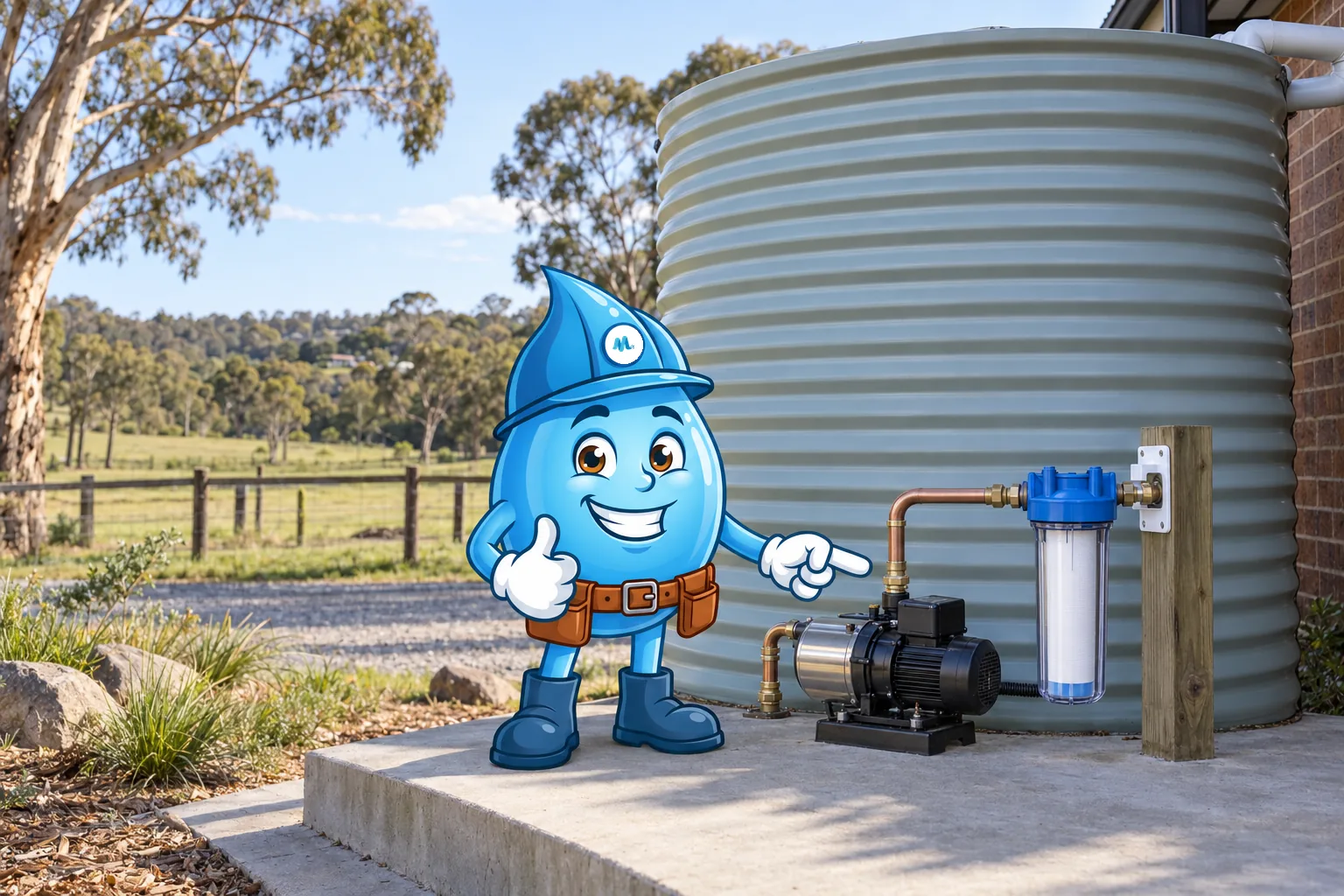
In NSW, plumbing work includes installing fittings that treat water, and it needs a licence. The Australian Building Codes Board says any product of a type on the WaterMark Schedule of Products must be WaterMark certified before it is installed, and installed by a licensed plumbing practitioner.
Sydney Water recommends a licensed plumber experienced with rainwater tanks. If tank water runs the toilet or washing machine, a property-specific backflow device may be required, and a NSW Fair Trading inspection is needed when a tank feeds a toilet, washing machine or hot water system, or is topped up by or switched to the mains. A rain to mains switch keeps water flowing when the tank runs dry. Ask for your Certificate of Compliance when the work is done.
Our licensed plumbers (Lic #306457C) repair tank pumps, filters and rain to mains switches (see rainwater tanks and pumps) and fit sediment and carbon filtration after the pump (see whole house water filters), with a fixed price quote before any work starts.
Bore Water, and When to Test Tank Water
For most tanks, NSW Health says a householder should not need to send water to a laboratory. Bore water is the exception, and there are a few times to look at a tank more closely.
- On bore water, always. A shallow bore can pick up germs or chemicals from urban, agricultural or industrial activity; a deep bore is less likely to carry germs but may contain heavy metals, other chemicals and radioactivity. NSW Health says to test for E. coli and a comprehensive chemical and physical range, including radioactivity, before use, and again if the taste, smell or colour changes.
- A bad smell or taste, or a small animal in the tank. Removing the source, disinfecting the tank with chlorine and fixing the way in should usually fix it without a test, but you may still want one.
- After a flood, storm or bushfire. NSW Health publishes separate advice on cleaning or protecting tanks for each.
- If a business serves rainwater to the public or staff, which needs a quality assurance program under the NSW Public Health Act 2010.
Where to Get It Tested
Your local Public Health Unit, on 1300 066 055, can help you find a NATA-accredited laboratory and explain the results. For a specific chemical in a bore result, get specialist treatment advice: UV does not remove chemicals.Source: NSW Health, rainwater page and Groundwater Treatment Fact Sheet
Boiling Is Not a Filter
A rolling boil destroys disease-causing microorganisms, but it does not remove chemicals, and NHMRC notes it does not remove or destroy PFAS.Source: NSW Health; NHMRC PFAS questions and answers
Rainwater Filter FAQs
Is rainwater tank water safe to drink?
It can be. NSW Health says a properly maintained rainwater tank can provide good-quality drinking water. Where town water is available, it recommends town water for drinking and cooking.
What is the best rainwater filter for drinking water?
For drinking, NSW Health describes a stack: a sediment pre-filter of about 20 micron, a 1 micron second stage, then a UV unit with a sensor and alarm, with carbon added for taste and smell. Look for the WaterMark and a named standard such as NSF/ANSI 53 or 55.
Do I need a UV filter on my rainwater tank?
Only if you want the water disinfected on its way to the tap. Carbon will not remove bacteria or viruses; UV is effective against most of them, but needs clear water and power and does not remove chemicals.
How often should I clean my rainwater tank?
Look inside every six to twelve months and remove any sludge, clear the gutters every three to four months, and check the screens at least once a year. NSW Health strongly recommends a professional cleaner for anything that means getting inside the tank.
Does rainwater have fluoride in it?
No. NSW Health says rainwater does not contain fluoride, and suggests asking your dentist about other sources, such as fluoride toothpaste.
Do I need a plumber to fit a rainwater filter?
Yes, if it connects to the water line. In NSW, installing fittings that treat water is plumbing work, and WaterMark products must be installed by a licensed plumber. Changing the cartridge afterwards is usually a do-it-yourself job; Puretec, for one, designs its cartridges for it.
Related: Whole house water filters · Rainwater tank and pump repairs · Water filter installation · Is Sydney tap water safe to drink? · How often to change filter cartridges · PFAS: which filters remove it