




Smell Gas in the House? What to Do Right Now, and What the Smell Means
If you can smell gas, act before you read: no flames, no switches, open the doors and windows, turn the gas off at the meter, leave the house and call from outside. Natural gas and LPG are given their smell on purpose so that a leak is noticed, and the smell alone is the reason to treat it as a leak until a licensed gasfitter has tested the system.
Mr Splash gasfitters answer 24 hours a day on 1300 677 752. For a strong smell, a hissing sound, or gas you cannot turn off, also call the gas network emergency line, Jemena on 131 909, from outside the house. Nothing below replaces those two calls.
The Six Things to Do in the Next Two Minutes
- Do not create a spark. No lighters, matches or candles, no cooktop, no cigarettes. Do not turn any light or appliance on or off, do not unplug anything, and do not use the doorbell or the garage door opener. Any of them can arc.
- Open doors and windows as you move through the house, to let the gas out and the air in.
- Turn the gas off at the meter. The meter is usually on the side or front of the house. The isolation valve is a lever or a small tap on the pipe going into it: turn it a quarter turn so the handle sits across the pipe, not along it. For LPG, turn the valve on top of each cylinder clockwise until it stops.
- Get everyone out, including pets, and move away from the house. Do not start a car in the garage.
- Call from outside. Mr Splash on 1300 677 752 for a licensed gasfitter, and Jemena on 131 909 for a strong smell, a leak you cannot isolate, or a smell outside near the meter or in the street.
- Stay out until it is tested. Do not turn the gas back on yourself. A gasfitter pressure-tests the system, finds the leak, repairs it and confirms it is safe before the supply is restored.
What the Smell Actually Means
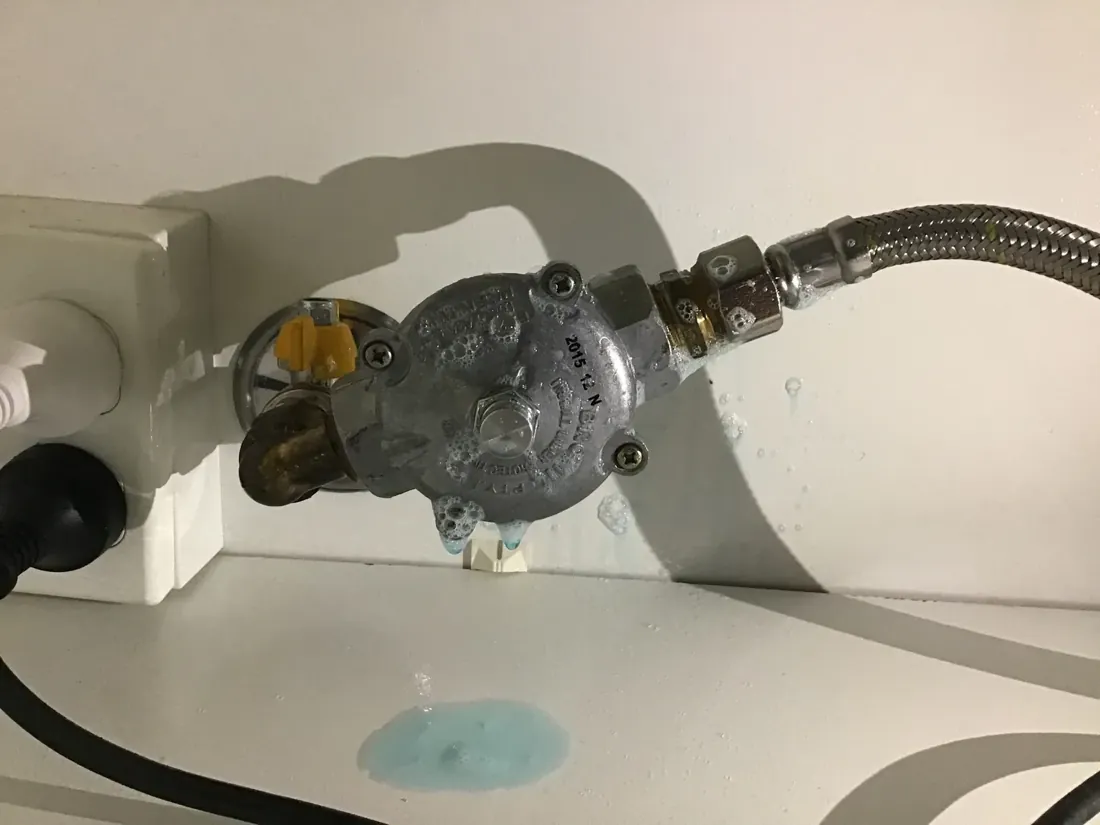
Natural gas and LPG have no smell of their own. The rotten-egg smell is an odorant added at the network so that even a small leak is noticed by the nose long before it is dangerous. That is why the rule is simple: if you can smell it, there is gas in the air that should not be there, and the size of the leak is not something you can judge by how strong the smell is. A faint smell at a cooktop that is off, a smell that comes and goes, or a smell only outside near the meter are all leaks until tested.
The one thing the smell does not tell you about is carbon monoxide, which has no smell at all. A gas appliance that is burning badly, with a yellow or sooty flame, a pilot that keeps going out, staining around a heater, or headaches and drowsiness when an appliance is running, is a carbon monoxide risk rather than a gas leak, and it needs the appliance turned off and serviced by a licensed gasfitter just as urgently.
Where the Gas Is Usually Coming From
A gasfitter finds the leak by testing, not by guessing, but these are the places it usually is.
A Cooktop Knob
A burner knob nudged partly on without lighting, or a knob that no longer shuts fully. The most common source of a gas smell in a kitchen, and the first thing to check once the room is ventilated.
An Unlit Pilot
A storage hot water system or an old heater whose pilot has gone out keeps letting a small amount of gas through. A smell near the water heater outside is often this.
Flexible Hoses and Bayonets
The braided hose behind a cooktop or the bayonet fitting for a portable heater. Hoses age, crack and get pulled when an appliance is moved; bayonets leak when the seal wears.
Appliance Connections and Regulators
Joints behind an oven, under a cooktop, or at a heater regulator work loose over years of heating and cooling. Found with a soap test, fixed by remaking the joint.
The Meter and Regulator
A smell outside at the meter is usually the regulator vent or a joint on the meter assembly, which is the network's equipment. That is a Jemena call as well as a gasfitter.
Buried and Concealed Pipework
Old pipe under a slab or in a wall corrodes and leaks slowly into the house or the garden. Found by a pressure test that drops with every appliance isolated, then traced.
LPG Is Different in One Way That Matters
Natural gas is lighter than air and rises, so it drifts up and out through open windows. LPG, the gas in cylinders, is heavier than air. It sinks and collects in low places: along the floor, in a cellar or a boat, under a house on piers, in a drain. Opening a window high up does little for LPG; it has to be swept out at floor level, and a pilot light or a fridge motor near the floor is the ignition risk.
With LPG, turn off the cylinder valves, not just the appliance, and keep people and cars away from the low side of the house until it has cleared. A cylinder that smells at the valve or the changeover regulator when it is closed should not be moved indoors and should be reported to the supplier.
Mr Splash gasfitters work on both natural gas and LPG systems. The gas repairs page covers cylinders, changeover valves and regulators.
What the Gasfitter Does When They Arrive
- Confirms the supply is isolated and the house is ventilated before anything else.
- Pressure-tests the installation. A gauge on the system with the appliances isolated shows whether the pipework holds pressure over a set time. A drop means a leak in the pipework; steady pressure points to an appliance.
- Isolates and tests appliance by appliance: cooktop, oven, hot water, heater, each connection and hose, with a detector and a soap solution at every joint.
- Traces a pipework leak by sections, which on old buried pipe can mean locating and exposing a corroded run rather than a joint.
- Repairs and retests, then restores the supply and relights the appliances only once the system holds pressure. Where the work requires it, you get a certificate of compliance for the gas work.
- Tells you what to replace. A perished hose, a bayonet past its life, a regulator out of date or a corroded run are named in the quote, as one fixed price, GST included, before the repair starts.
What Not to Do
Do Not Look for the Leak With a Flame
It sounds absurd and it still happens. The soap test is the only safe test a household can do, and only after the house is ventilated.
Do Not Tape or Seal a Joint
Tape, putty and sealant on a gas joint are illegal and do not hold. A leaking joint is remade by a licensed gasfitter.
Do Not Relight a Pilot That Keeps Going Out
Once, following the instructions on the unit, is fine when there is no smell. Repeated relighting with a smell in the air is not.
Do Not Turn the Gas Back On Yourself
If it was turned off for a smell, it stays off until the system has been pressure-tested. The leak is still there.
Do Not Ignore a Faint Smell
Faint today is not faint tomorrow. A smell that comes and goes is a leak that has not been found yet.
Do Not Do the Gas Work Yourself
In NSW all gasfitting work, including connecting a cooktop, must be done by a licensed gasfitter. Mr Splash Plumbing holds NSW Lic 306457C.
Gas Smell Questions, Answered
What should I do if I smell gas in my house?
Do not operate any switch, flame or appliance. Open doors and windows, turn the gas off at the meter (or at the LPG cylinders), get everyone outside and call from outside: Mr Splash on 1300 677 752 for a licensed gasfitter, and Jemena on 131 909 if the smell is strong or you cannot isolate it. Stay out until the system is tested.
How do I turn the gas off at the meter?
Find the meter, usually on the side or front of the house. On the pipe into it is a lever or a small tap: turn it a quarter turn so the handle sits across the pipe, which is off. For LPG, turn the valve on top of each cylinder clockwise until it stops.
Is a faint gas smell dangerous?
Treat it as a leak. The odorant is added so that even a small leak is noticed, and the strength of the smell does not tell you the size of the leak or which way it is heading. Ventilate, isolate the gas and have it tested.
Why does my house smell like gas but nothing is on?
Common causes are a cooktop knob nudged partly open, a pilot light that has gone out on a hot water system or heater, a perished flexible hose behind an appliance, or a slow leak in concealed pipework. A gasfitter pressure-tests the system to find which.
Who do I call for a gas leak in Sydney?
A licensed gasfitter to find and repair the leak; Mr Splash answers 24 hours a day on 1300 677 752. For a strong smell, a leak you cannot isolate, or a smell at the meter or in the street, also call the gas network emergency line, Jemena, on 131 909.
Can I use my phone if I smell gas?
Not inside the house. Go outside first, then call. Any electrical device can spark, and the phone is one you are holding.
What does gas leak detection cost?
It depends on whether the leak is at an appliance or in the pipework and how far it has to be traced. Mr Splash quotes the detection and any repair as one fixed price, GST included, once the gasfitter has seen the system. After-hours call-out fees are at Mr Splash's discretion and confirmed before attending.
Related: Gas leak detection · Gas repairs · 24/7 emergency plumbing · No hot water: what to check